

Let’s be honest: staring at a blank page with the cursor blinking is the most stressful part of job hunting. You know you have the skills, but putting them into a document that actually gets read? That’s a different battle.
If you are wondering how to write a CV for a job in today’s market, you are not alone. The rules have changed. In 2026, you aren’t just writing for a human hiring manager; you are writing for robots (ATS) and humans simultaneously.
Whether you are applying for project manager jobs or preparing for a government role like the FPSC CSS exam, this guide will walk you through the process step-by-step.
Table of Contents
Phase 1: Research First (Don’t Skip This)
Before you type a single word, stop. The biggest mistake candidates make is writing a “generic” CV and spraying it across the internet.
To stand out, you need to understand who you are writing for.
- Analyze the Job Description: Highlight the specific keywords they use (e.g., “Python,” “Project Management,” “Communication”).
- Know the Document: In the US, a “CV” is a long academic document. In the UK, Pakistan, and New Zealand, a “CV” is what Americans call a “Resume”—a 1-2 page summary of your career. This guide focuses on the latter standard.
- Check the Trends: As noted by Indeed, modern CVs must be “skimmable.” Recruiters spend about 6 to 8 seconds on their first scan.
Phase 2: Choose Your Format
Your layout is your first impression. If it looks cluttered, it gets deleted.
The Gold Standard: Reverse-Chronological
For 90% of job seekers, the Reverse-Chronological format is best. This means listing your current or most recent job first and working backward. It is what hiring managers expect and what Applicant Tracking Systems (ATS) read most easily.
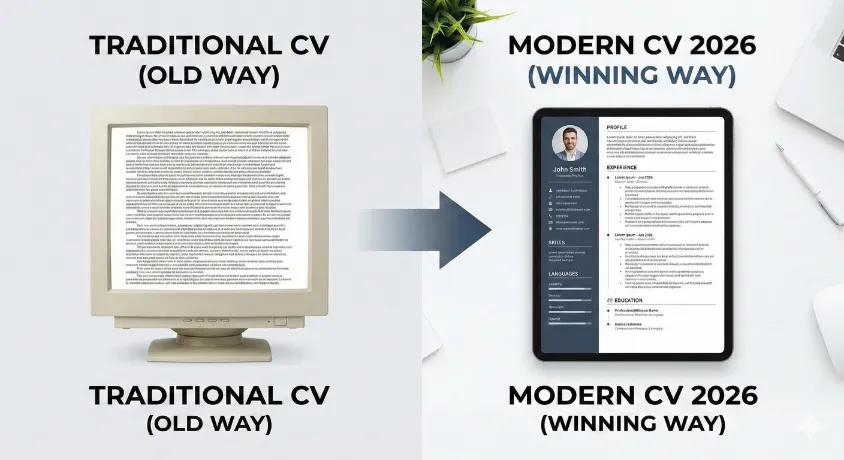
Traditional vs. Modern (2026) CVs
How does a modern CV differ from the old style?
| Feature | Traditional CV (The Old Way) | Modern CV 2026 (The Winning Way) |
| Objective | “Looking for a challenging role…” | Professional Profile (A 3-line “elevator pitch” of value). |
| Duties | Listed generic responsibilities. | Achievements (Quantified results, e.g., “Increased sales by 20%”). |
| Skills | “Hard worker,” “Team player.” | Hard & Digital Skills (e.g., “SEO,” “Python,” “Asynchronous Communication”). |
| Length | 3-4 pages. | 1-2 pages maximum. |
| Tech | Sent as a Word Doc (.doc). | Sent as a PDF (unless the job ad explicitly asks for Word). |
Phase 3: The Anatomy of a Perfect CV
Let’s break down the sections you need to include, in order.
1. Contact Information
Keep it clean. You need your name, phone number, professional email, and a link to your LinkedIn or portfolio.
- Privacy Note: You do not need to include your full home address, marital status, or date of birth. As Careers NZ (Tahatū) advises, protecting your privacy is crucial in the digital age.
2. The Personal Profile (Your Hook)
This is the most important paragraph on the page. Ditch the old “Objective” statement. Instead, write a Professional Summary that tells them what you can do for them.
Bad: “I am looking for a job in marketing to gain experience.”
Good: “Digital Marketing Specialist with 3 years of experience managing SEO campaigns. Proven track record of increasing organic traffic by 40% and optimizing ad spend for ROI.”
3. Work Experience
This is the “meat” of your CV. List your roles in reverse-chronological order.
- The Golden Rule: Don’t just list duties (what you were supposed to do). List achievements (what you actually did).
- Use the STAR Method: For every bullet point, think Situation, Task, Action, Result.
- Example: “Spearheaded a new inventory system (Action) that reduced waste by 15% (Result).”
For specialized roles, such as the Pakistan Army Lady Cadet Course, your experience section should highlight physical fitness, discipline, and leadership roles explicitly.
4. Education
If you have experience, keep this brief (Degree, University, Year). If you are a fresh graduate, you can expand this section to include relevant modules or a dissertation title.
- Tip for Students: The National Careers Service suggests placing education before work experience only if you are a school leaver or new graduate.
5. Skills (The Keyword Magnet)
Split this into Hard Skills (Technical) and Soft Skills (Interpersonal).
- Hard Skills: HTML, Project Management, Accounting, Forklift Driving.
- Soft Skills: Leadership, Adaptability, Emotional Intelligence.
- 2026 Update: Include “Digital Literacy” or AI-related skills (like “Prompt Engineering” or “ChatGPT Proficiency”) if relevant. Employers now value candidates who can use AI tools ethically.
Phase 4: Special Scenarios
How to Write a CV with No Experience
Are you a student or fresh graduate? Don’t panic. You have more “experience” than you think.
- Focus on Projects: Did you build a website for class? Organize a charity event? That is work experience.
- Volunteering: Unpaid work shows character and reliability.
- Education as a Job: Treat your degree like a job. List the skills you learned (research, public speaking, deadline management).
- Resource: Check out the Prospects.ac.uk guide for graduates—it specifically covers how to leverage your degree modules.
The “Gap” in Employment
If you have a gap in your CV, address it briefly in your cover letter or a single line in the CV. “Taken time for personal development” or “Sabbatical for travel” is perfectly acceptable in 2026. Honesty builds trust.
Phase 5: The “Robot Test” (ATS)
Most large companies use Applicant Tracking Systems (ATS) to filter CVs before a human ever sees them.
- Avoid: Graphics, logos, tables, and columns (unless you are a designer). These confuse the robots.
- Do: Use standard headings like “Work Experience” and “Education.”
- Keywords: If the job description says “Content Writing,” make sure the phrase “Content Writing” appears in your CV.
Conclusion: Your Next Step
Writing a CV is about confidence. It is a document that says, “I have value, and here is the proof.”
Once your CV is polished, the next step is finding the right opportunity. Whether you are browsing general listings on The Job Spot or looking for niche opportunities, a strong CV is your ticket to the interview room.
Checklist before you send:
- Is it under 2 pages?
- Is it in PDF format?
- Did you remove “References available upon request” (it wastes space)?
- Did you tailor the keywords to the specific job ad?
Now, go hit “Apply” with confidence!



2 thoughts on “How to Write a CV for a Job: 5 Easy Steps to Get Hired (2026)”